
The Coastal Advisory Panel (CAP)
- KCDC formed the Coastal Advisory Panel (CAP) in 2020 to work through a process and report back to them in May 2024
- CAP are using the Jacob’s Report* which includes extreme and implausible modelling relating to sea level rise.
- Five Coastal Adaptation Areas (CAA’s), otherwise known as hazard areas, have been identified based on this modelling. More information on the CAA’s can be found under “will this affect you”
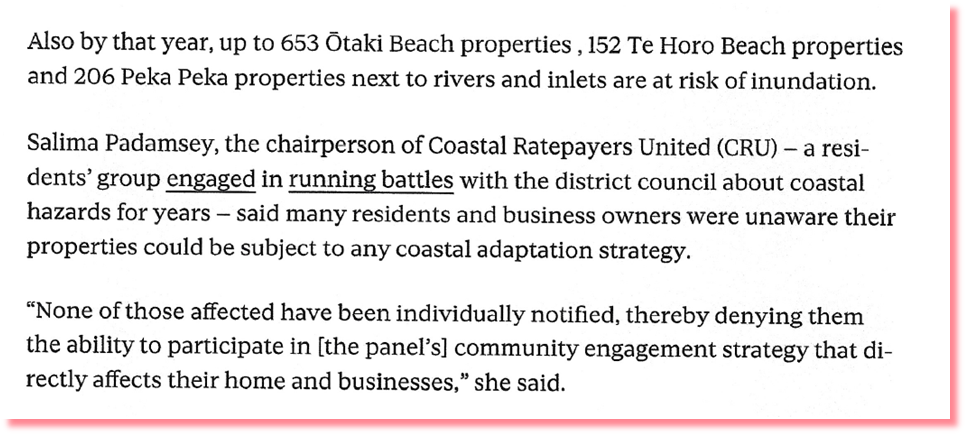
- CAP’s engagement has been flawed due to lack of effective notification of community meetings and feedback, and it is not following a democratic process
(* Jacobs New Zealand Limited is a consultancy firm engaged by KCDC to assess our district for coastal hazards)
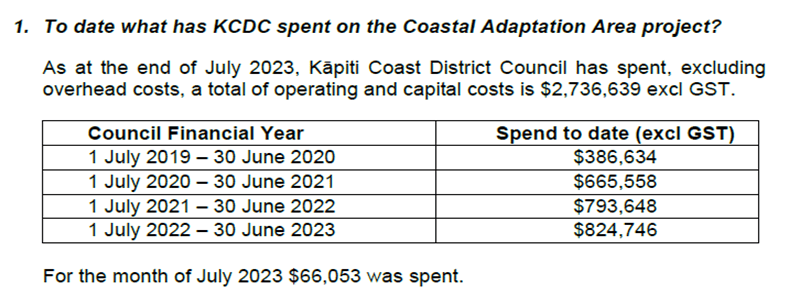
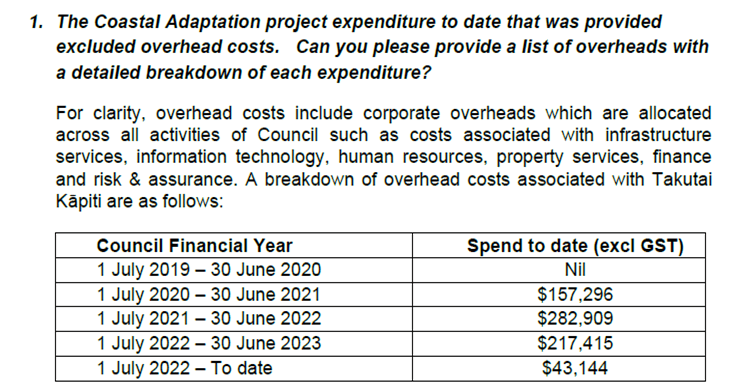
The CAA process has already spent over $3M of ratepayer’s money
Extreme Modelling
- The extreme modelling creates an exaggerated CAA which captures many residents in a hazard zone up to 2km back to old SH1
- The Jacob’s Report uses the IPCC (Intergovernmental Panel on Climate Change) RCP/SSP 8.5H+ modelling (the H+ model is not used anywhere else in the world!) – this is extreme and IPCC now recognise this as implausible. (ref: 1 & 1A)
- The modelling appears to EXCLUDE sea walls and natural barriers (ref: 2)
- The modelling is based on a high energy rocky shoreline but we have a sandy coastline (ref: 3)
- Have the unique geological features of Kapiti’s coastline been correctly included in modelling? eg. accreting coastline and landmass rise (ref: 3)
Undemocratic Process
- KCDC/CAP have failed to raise sufficient awareness for community engagement (attendance at the first two workshops was poor with only 20 residents for Northern and 30 for Central areas).
- The Raumati Community Workshop (July 2023) saw a large representation of residents (around 200) challenge CAP’s science and process which then prompted KCDC to limit Paekakariki workshop attendees to no more than 60 people (registration only!)
- KCDC have now (Nov ’23) announced that all further community engagement after the Paekakariki workshop will be held on-line via zoom!
- At every workshop a conflict of interest occurred when KCDC/CAP staff participated at the tables. The process is easily corruptible as every view is given equal attention, eg. one opinion would have the same weighting as that of the majority of participants, which will skew results and reports.
- The 4 basic workshop questions are designed to give an outcome that CAP wants, NOT what the community want. Many felt they were being pushed to a tokenistic, predetermined outcome.
(Katharine Moody (BSc, PGDipPlan) – senior tutor at Massey University’s College of Humanities and Social Sciences)

- KCDC/CAP to date refuse to discuss the extreme modelling and dismiss anyone who challenges them. CAP continues to bully and make personal attacks on anyone who questions them. (ref: 4)
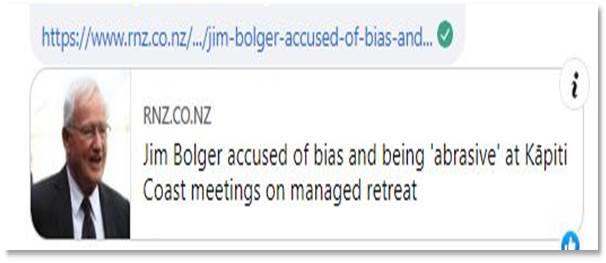
- Many letters of complaints regarding the Raumati Workshop were sent to KCDC about Mr Bolger’s behaviour, the undemocratic process and the science used. Responses to date have been absent or unsatisfactory.
KCDC are not listening to their community
- It has been repeatedly pointed out to CAP and KCDC by many ratepayers and Coastal Ratepayers United (CRU) over several years that the science is flawed at best and misleading at worst. Unfortunately to date KCDC/CAP have not satisfactorily answered these concerns. CRU with 500 members has stated they have no confidence in the CAP process
- CAP are due to report back to KCDC in May 2024 – time is running out for KCDC to respond appropriately to the community and for the community to take action
Alarmist Outcomes
- Managed Retreat – there is an inexplicable push for predetermined alarming outcomes – 1,000+ homes have already been identified by CAP for managed retreat based on potential implausible risks not actual events. (ref: 5)
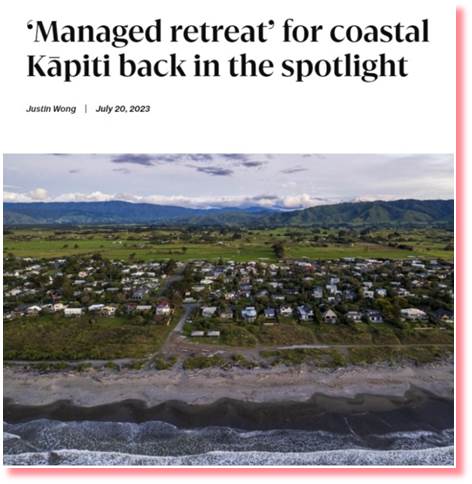

- CAP’s push for Managed Retreat alarmingly aligns with recent documents tabled at Parliament for legislation:
From the Ministry for the Environment:
1. “Report on the Expert Working Group on Managed Retreat” – proposes to evict you from your home with little to no compensation, and potentially cancel your title
2. “Community-led retreat and adaptation funding: Issues and options” – oddly these policies seem to be in line with the CAP predetermined outcomes.
Who Pays? – You Do
Ratepayers are not only paying for the cost of this process ($3M+ spent to date) there will be more financial implications.
COST OF MANAGED RETREAT
- The current value of the 1,000+ homes already identified for Managed Retreat is substantial
- The compensation cost could be even more substantial because the CAP process is only 25% complete, with three more zones to assess
- The compensation offered to property owners could be reduced if homes are significantly devalued
COST OF COASTAL ADAPTATION AREAS (CAA’s)
- This will apply to any natural hazard, eg. flooding, slips, storm surge and erosion – which would encompass most properties in Kapiti.
- If CAP’s Coastal Adaptation Areas are accepted by Council and applied to Titles/LIM’s, this could trigger:
- Insurance costs – increased/limited/declined
- Mortgages – increased/limited/declined
- Inability to buy/sell/refinance your home or business
- Devaluation of your home and possible low payout for homes identified for Managed Retreat compensation
- In addition, existing mortgages could be vulnerable for recall by banks if property values fall below the outstanding debt
Who Benefits? – NOT YOU

- Consultants
- Local/central Government job
 KAPITI C.A.L.M.